Project: Argo
Lead scientist at WHOI: Susan Wijffels, senior scientist
Department and location: Physical Oceanography, 207A Clark Building, Quissett Campus
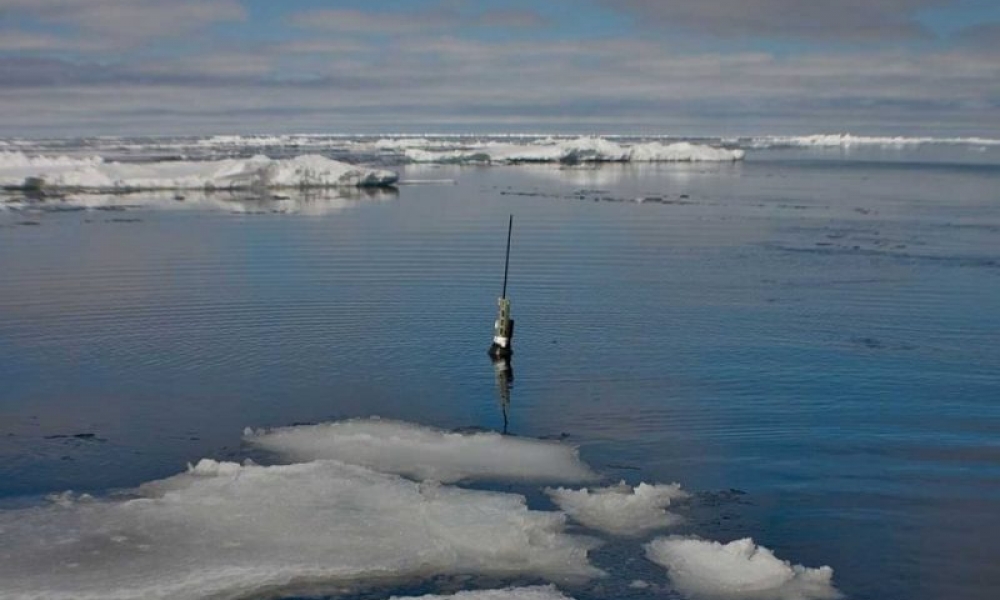
Courtesy UC San Diego
The Argo program
Argo is a global ocean observing system. A worldwide fleet of robotic instruments (floats) drift with the currents and move up and down between the ocean surface and deeper water, collecting vital information on the ocean’s physical, biological, and chemical characteristics. The name “Argo” was chosen because the array of floats works in partnership with Jason Earth observing satellites, which measure the shape of the ocean surface. (In Greek mythology, Jason sailed on his ship the Argo in search of the golden fleece).
The original Argo array—physical ocean properties
- The original Argo program, which began in 1999, was the first global, subsurface ocean observing system. Consisting of 3,900 robotic floats, the array provides information on temperature, salinity, and depth in the water column throughout the global ocean.
- Each Argo float costs between $20,000 and $150,000, depending on the individual float’s technical specifications.
- A float is launched from a ship, and its weight is carefully adjusted so that it sinks to a pre-set level, usually a depth of 1,000 meters (0.62 miles or 3,281 feet). Ten days later, an internal battery-driven pump transfers oil between a reservoir inside the float and an external bladder. This makes the float first descend to 2,000 meters (1.2 miles or 6,562 feet) and then return to the surface, measuring conductivity (salinity), temperature, and pressure (depth) as it rises.
- Once the float is on the surface, it gets its location through GPS, and then communicates with a satellite to send its data to receiving stations on shore and receive any new mission instructions. For the majority of the Argo fleet, this surface interval is between 15 minutes and one hour.
- The float then sinks again to repeat the 10-day cycle until its batteries are exhausted, usually 5–8 years later.
- As of 2020, Argo is collecting 400 data profiles every day, or 12,000 each month—greatly surpassing the amount of data that can be collected from below the ocean surface by any other method.
- Data from the Argo array are publicly available and shared within 24 hours of observation. Since Argo’s inception, its data have generated 4,100 scientific publications.
The original Argo array—How is WHOI involved?
- WHOI was a founding member of the U.S. Argo program, which represents about half of the global Argo effort. Breck Owens (emeritus, Physical Oceanography) was part of the original concept team (as was Susan Wijffels, but she was in Australia at the time).
- Currently, WHOI is one of the four float providers for U.S Argo; the other three are Scripps Institution of Oceanography, the University of Washington, and NOAA’s Pacific Marine Environmental Laboratory (NOAA PMEL).
- NOAA’s Atlantic Oceanographic and Meteorology Laboratory (NOAA AOML) is the U.S. data center for Argo, and the Navy Research Lab in Monterey, Calif. is the U.S. Global Data Assembly Center (one of two, globally).
- WHOI provides international leadership for Argo: Susan Wijffels co-chairs the international Argo Steering Team, and Breck Owens is international Argo Director.
Biogeochemical Argo—biological and chemical ocean properties
- Biogeochemical-Argo (BGC-Argo) builds on the Argo program, adding biological and chemical sensors to Argo’s core sensors for temperature, depth, and salinity. The program comprises a number of projects and geographical focus areas; WHOI is involved in one of them, the new NSF-funded GO-BGC Array.
- On October 29, 2020, the National Science Foundation approved a five-year, $53 million grant to a consortium of five of the country’s top ocean-research institutions to build a global network of chemical and biological sensors called the Global Ocean Biogeochemistry Array(GO-BGC Array).
- Scientists at the Monterey Bay Aquarium Research Institute (MBARI), Woods Hole Oceanographic Institution (WHOI), University of Washington, Scripps Institution of Oceanography, and Princeton University will use this grant to build and deploy 500 robotic ocean-monitoring floats around the globe to collect observations between the surface and a depth of 2,000 meters (6,562 feet).
- Similar to floats currently operating in the Southern Ocean as part of the SOCCOM program (launched in 2014, WHOI not involved), the new GO-BGC floats will carry a number of chemical and biological sensors in addition to the core Argo sensors for temperature, depth, and salinity.
- These include instruments to measure oxygen concentration, pH (ocean acidity), nitrate (an essential nutrient for microscopic algae), sunlight (required for algal growth), chlorophyll (an indicator of algal populations), and particles in the water (including microscopic algae). Over the last few years, researchers have been testing, refining, and calibrating these sensitive instruments as part of the SOCCOM program and other international efforts.
- Data streaming from the float array will be made freely available within a day of being collected, and will be used by scores of researchers, educators, and policy makers around the world.
Deep Argo—reaching to the sea floor
- Large-scale ocean circulations extend from the sea surface to the ocean bottom, but existing Argo floats cannot operate below 2,000 meters (6,562 feet). It is critical that we be able to track the characteristics of these flows because their strength and variability drive the uptake and transport of heat and freshwater, and the melting of sea ice, which in turn drive global climate, regional weather patterns, and sea level rise.
- To reach beyond 2,000 meters (6,562 feet), Argo floats and sensors need to be re-engineered to deal with the much higher pressures and much smaller signals (e.g. lower concentrations) in the deep ocean.
- A Deep Argo mission will be the same as for original Argo, but floats will measure the full ocean depth and carry more accurate sensors.
- The planned Deep Argo array will consist of 1,250 deep floats distributed evenly across the global ocean.
- WHOI will deploy its first Deep Argo float in early 2021, contributing to a building global pilot project.
Why are Argo and other ocean observing systems important?
- The Argo program has changed the way scientists think about collecting and managing ocean data—making it available and accessible to the entire scientific community and thereby strengthening international collaboration.
- Data from the original Argo fleet are crucial for weather forecasting and to inform our understanding of the relationships and feedbacks between the ocean and global climate, helping us to improve estimates of how climate varies from year to year and how it will change in the future.
- Argo is also helping us predict sea level rise, which is driven in part by melting ice but also by the amount of heat stored in the ocean. Argo’s temperature measurements allow us to calculate how that stored heat varies from year to year, with depth, and from region to region. As the heat content of the ocean increases, sea levels rise, analogous to the mercury in a thermometer.
- Biogeochemical Argo will further enhance our understanding of ocean-climate linkages and provides data on ocean productivity and overall ocean health. These include information on the growth and respiration of phytoplankton (drifting algae and microbes that use sunlight as a source of energy) and the nutrients and light that control these processes.
- In addition to supporting most other ocean life—including commercial fisheries—phytoplankton supply oxygen to and remove carbon dioxide from the ocean and the atmosphere. These microscopic plankton have huge impacts on our climate through their control on carbon dioxide levels in the atmosphere.
- Biogeochemical Argo will also provide first-hand data on long-term changes in the ocean, including ocean acidification and the expansion of low-oxygen zones.