About WHOI
Tucked away in a picturesque seaside village of Cape Cod, Massachusetts, sits a powerhouse of ocean science and innovation. Woods Hole Oceanographic Institution (WHOI) is the world’s largest independent organization dedicated exclusively to ocean research, engineering, and education. Its mission: to drive discovery and advance understanding of the ocean and its benefits to human society and the planet.
Dedicated to ocean discovery, exploration, and education
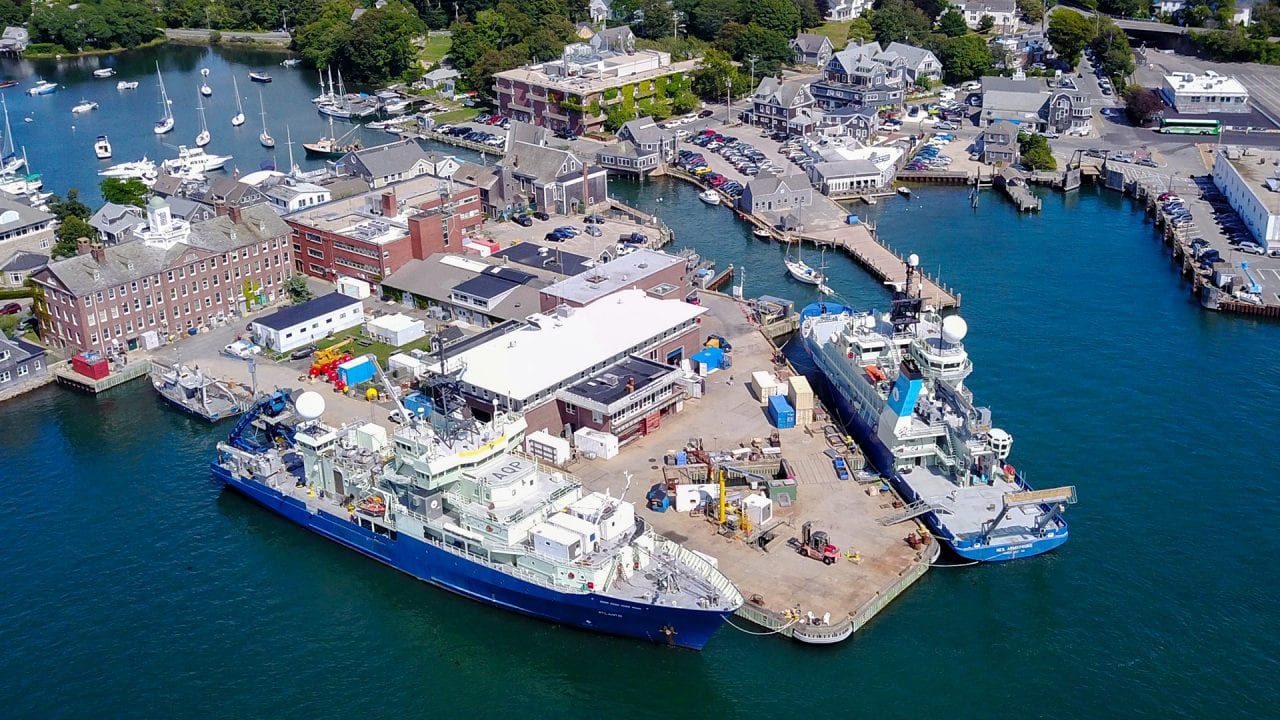
Founded in 1930, WHOI began with a dozen scientists, a single laboratory building, and a small wooden research vessel: the 142-foot ketch Atlantis, whose profile still appears on the Institution’s seal. Today, WHOI is home to more than 1,000 employees spread across three campuses and operates a fleet of roughly 100 ocean-going research vessels. This fleet includes two large ships (R/V Neil Armstrong and R/V Atlantis), a smaller coastal research vessel (R/V Tioga), and dozens of underwater vehicles, including purpose-built robotic and remotely operated vehicles and the iconic human-occupied submersible Alvin.
WHOI ranks fifth among all academic institutions in Massachusetts for capturing federal research dollars, with the top four being major universities such as Harvard and MIT. Nationally, our researchers win one in every three dollars of National Science Foundation funding for ocean research. And we are instrumental in the Blue Economy, directly and indirectly creating almost 3,900 jobs and $604 million dollars in business revenue.
Today, WHOI researchers are engaged in upwards of 800 concurrent projects to provide critical information about some of the most urgent challenges facing humanity. WHOI’s biologists, chemists, geologists, physicists, engineers, marine policy experts, ship’s crew, technicians, and other staff are widely recognized as leading experts in their fields.
WHOI also equips new generations of ocean researchers, engineers, and explorers with the skills and knowledge they need to make a difference. Since 1968, WHOI has partnered with the Massachusetts Institute of Technology to operate a joint PhD program, which is now among the world's most prestigious graduate programs in marine science. And for more than five decades, WHOI alumni have helped extend the frontiers of scientific knowledge, rising to leading positions in government agencies, the U.S. Navy, private companies, non-governmental organizations, and academic programs around the globe.
A legacy of breakthrough success
WHOI boasts a storied history of exploration, technological innovation, and discovery. The discoveries made by WHOI’s scientists and engineers have contributed to improving our environment, commerce, health, national security, and quality of life.
The Institution is probably best known for ocean exploration and discovery. Notable achievements include: discovering the first-known active hydrothermal vent on the seafloor of the Galápagos Rift in 1977, shattering the long-held notion that life could not exist on the ocean bottom; locating the wreck of the Titanic in 1985, using specialized imaging systems of WHOI's own invention; locating the wreckage of Air France flight 447 in 2011; and finding the voyage data recorder of the El Faro in 2016.
A unique combination of strengths
WHOI’s work at the leading edge of oceanographic research and innovation is based on a combination of three coequal strengths:
- Deep scientific understanding of the ocean and how it works;
- Unmatched engineering talent and entrepreneurship that make it possible to invent and build the technologies that drive discovery; and
- World-class marine operations that offer extraordinary access to the sea.
In 2010, this powerful combination enabled WHOI to respond immediately to the Deepwater Horizon oil spill, deploying scientific and technological resources to provide critical onsite data and analysis of the largest marine oil spill in U.S. history. A year later, when an earthquake and tsunami damaged the Fukushima Daiichi nuclear power plant in Japan, WHOI was there to sample ocean water and fish for radioactive contamination and inform emergency personnel, government officials, and the public.
WHOI continues to take on many of the ocean’s most sweeping challenges. In 2018, the Institution launched an ambitious new mission to explore and understand one of our planet’s last hidden frontiers: the ocean twilight zone. This biologically-rich but little-understood region hundreds of feet below the ocean’s sunlit surface plays a crucial role in ocean ecosystems and global climate. WHOI also leads the Ocean Observatories Initiative (OOI), a global scale program funded through the National Science Foundation’s largest-ever investment in ocean science. This multi-site, multi-institution project supports large-scale mooring arrays and a fleet of autonomous vehicles. The OOI’s ocean-observing systems operate around the clock, 365 days a year, collecting data from the ocean surface down to the seafloor and making it available to anyone with an internet connection, much of it in near-real time.
With today’s rapidly changing climate, growing global population, and decreasing land-based resources, understanding the ocean has never been more important. The breakthroughs achieved by WHOI’s scientists and engineers contribute to improving our environment, commerce, national security, and quality of life, empowering people and policies that will ensure the health of our planet for generations to come.
With your help, we work for the good of our ocean, our planet, and our future.
FACTS
Founded: 1930
Location: Woods Hole, Massachusetts, U.S.A; 219 acres of land and waterfront; 58 buildings and laboratories; one-acre deep-water dock and port facility
Type of Organization: Independent non-profit
Funding: Government grants and contracts, foundation and private donations, industry contracts. Annual operating budget of $215 million
Research Areas: A wide range of topics related to ocean and earth science and marine policy; including interdisciplinary work related to the coastal ocean, ocean life, ocean exploration, and climate change
Departments & Divisions: Six research departments and more than 40 centers and labs
People: Approximately 950 employees, including more than 500 scientists, engineers, ship's crew, and technicians
Academics: Accredited by NEASC; Ph.D. and M.S. degrees offered in partnership with MIT; postdoctoral, undergraduate, summer, and guest student programs; more than 1,000 alumni/ae, including many in leadership positions in ocean science and policy worldwide
Ships: Global Class research vessel Atlantis, Ocean Class research vessel Neil Armstrong, coastal vessel Tioga, small boats
Underwater Vehicles: Human-occupied submersible Alvin; remotely operated vehicle (ROV) Jason/Medea; autonomous underwater vehicle (AUV) Sentry; additional hybrid ROVs, AUVs, and towed vehicles.
National Facilities: National Deep Submergence Facility (NDSF); National Ocean Sciences Accelerated Mass Spectrometer (NOSAMS); Northeast National Ion Microprobe Facility (NENIMF)
Technology transfer: 17 WHOI-related start-ups spun-off; 75 patents generated; 30-40 new technology disclosures