Project: The WHOI Reef Solutions Initiative
Lead scientist at WHOI: Amy Apprill (MC&G)
Marine Chemistry & Geochemistry, Fye Building, Quissett CampusCampus
Team members: Yogi Girdhar (AOP&E), Colleen Hansel (MC&G), Konrad Hughen (MC&G), Yaqin Liu (MPC), Matt Long, (MC&G), Jason Kapit (AOP&E), Aran Mooney (Biology), Gordon Zhang (AOP&E)
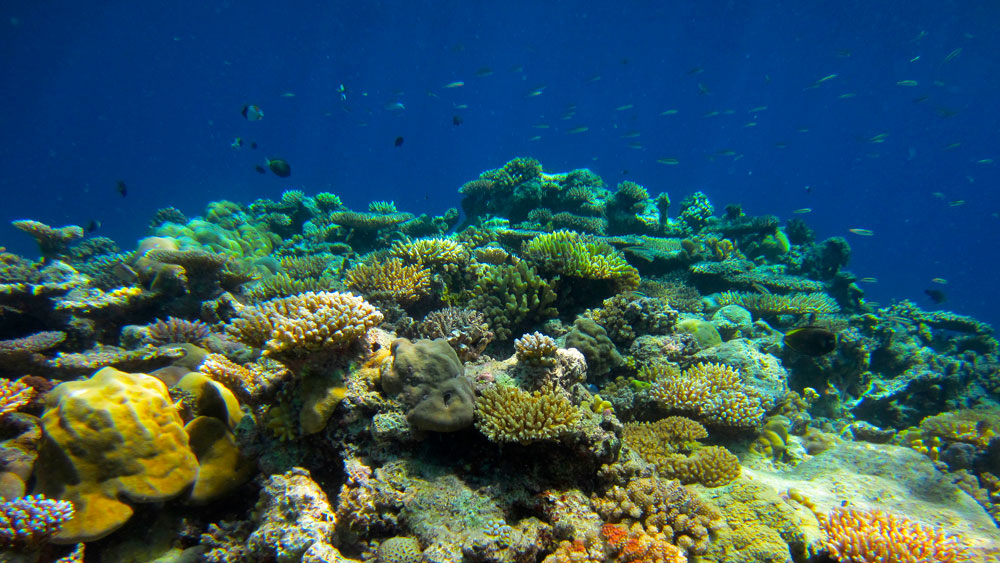
The WHOI Reef Solutions Initiative
The WHOI Reef Solutions Initiative seeks to elevate coral reef studies and conservation efforts to a completely new level and ensure the future of coral reef ecosystems through transformative science and technology innovations. Using a convergence research approach and an accelerated research timeline, the team will integrate knowledge, expertise, and methods across disciplines to develop and apply novel technologies and experimental frameworks to enable solutions to help save coral reefs and the coastal communities that reefs protect and support.
Major project themes
1. Technology-driven reef monitoring
- Goals: To outfit specific reefs with proven and newly developed technologies to monitor reef dynamics on unprecedented scales.
- Strategy: WHOI robotics engineer Yogi Girdhar is working to develop “smart” robots with vision-guided capabilities to observe and sample coral reefs on greater spatial and temporal scales.
- Outcomes: Obtain key insights into how corals and other reef organisms function and respond to their environment. Enhance understanding of the features of a healthy reef system. Monitor the health of restored reefs.
2. Diagnosing coral stress and enhancing coral health and resilience
- Goals: To identify diagnostic indices of coral health and subsequently develop and deploy novel sensors to monitor these infochemicals. Develop new treatments to decrease coral stress and enhance coral survival and resilience.
- Strategy: One novel and transformative technology that the team will use to diagnose coral stress is DISCO (DIver-operated Submersible Chemiluminescent sensOr), a device conceived by Senior Scientist Colleen Hansel and developed by a team of WHOI scientists and engineers. DISCO measures superoxide, a form of oxygen that is so reactive it vanishes within 30 seconds after forming. All organisms, including humans, produce superoxide for basic life functions, but high concentrations are produced during times of stress, which can be detrimental – even fatal.Using DISCO in situ on reefs, Hansel is investigating whether corals produce more superoxide to protect themselves from invading pathogens during stress events, such as increased sea temperatures that lead to bleaching or the onset and spread of disease. In this way, measurements of superoxide made using DISCO may provide a key diagnostic indicator of coral stress.
- Outcomes: Inform intervention strategies and reveal mechanisms and triggers that cause stress, disease and decline of coral health. To develop treatment options (e.g. probiotics, bleaching treatment) to promote coral resilience.
3. Rebuilding and restoring reefs
- Goals: To apply oceanographic expertise to determine locations for restoration and develop technology-aided replanting efforts for corals and other reef life. To develop science-driven solutions to attract reef life able to survive future climate conditions.
- Strategy: Corals and other reef life use cues to determine the best reef habitat to settle in for their lifetime. WHOI scientists have shown that coral larvae are attracted to reefs that sound healthy, enabling reefs with abundant fish to continue to attract new corals. The team will develop intervention strategies using sound and infochemical cues to help corals, fish and other reef life repopulate damaged or degraded reefs.
- Outcomes: Significantly improve the success rate of coral restoration efforts and create reef communities resilient to ocean warming.
4. Policy impact and public engagement
- Goals: To apply new, engaging ways of communicating to the public and to decision-makers about the importance of coral reefs. To advocate for the fundamental advances in technological development needed to study, monitor, and restore these ecosystems in order to effect rapid, positive change in their health and resilience.
- Strategy: Of particular interest to policymakers and the public will be the team’s focus on developing tools to diagnose the health of corals, which could enable reef health monitoring programs to inform policymakers of the status of reef health and allow for informed intervention. Results will be made publicly available (locally and online), thus allowing the public to engage with the science and check the health status of specific coral reefs (as one may check for beach closures due to a harmful algal bloom).
- Outcomes: Empower the public and policymakers to take meaningful action in support of coral reef protection and restoration.
Project motivation: Corals are important—and under threat
- Coral reefs are among the most biodiverse of all Earth’s ecosystems.
- Worldwide, they provide over $375 billion per year in goods and services and support over 500 million jobs.
- Human activities and their impacts—climate change, overfishing, and pollution chief among them—are killing corals at unprecedented rates.
- Over 25% of coral reefs have vanished in the last 30 years and 67% of our remaining coral reefs are on their way to extinction.
- In the U.S., Florida’s coral reefs have suffered a 90% decline over the past 40 years, resulting in altered coastlines and reduced storm resilience.
Project rationale: We must advance coral science to successfully sustain coral reefs
- Today’s coral reef science is inadequately funded and has limited scientists’ ability to produce the decisive empirical knowledge necessary to develop sustainable solutions for reefs.
- The health and function of reefs are primarily assessed by divers or satellites through image-based surveys. These methods only cover a tiny fraction of global reefs (divers) and are limited to the top 10 meters depth (satellites), and these observations do not account for the mechanisms and processes underlying coral stress and death, or how best to enable resilient or resistant coral reef communities.
- The current use of visual symptoms to assess coral and reef health is a roadblock in applying remediation and mitigation strategies for coral preservation and new approaches are needed to provide early indicators of the onset of coral and ecosystem stress.
- Without advancing the state of coral reef science, any effort of saving reefs will not be effective, efficient or sustainable.