Project: The Ocean Twilight Zone
Lead scientist: Heidi Sosik
Department and location: Biology, Redfield Building, Village Campus
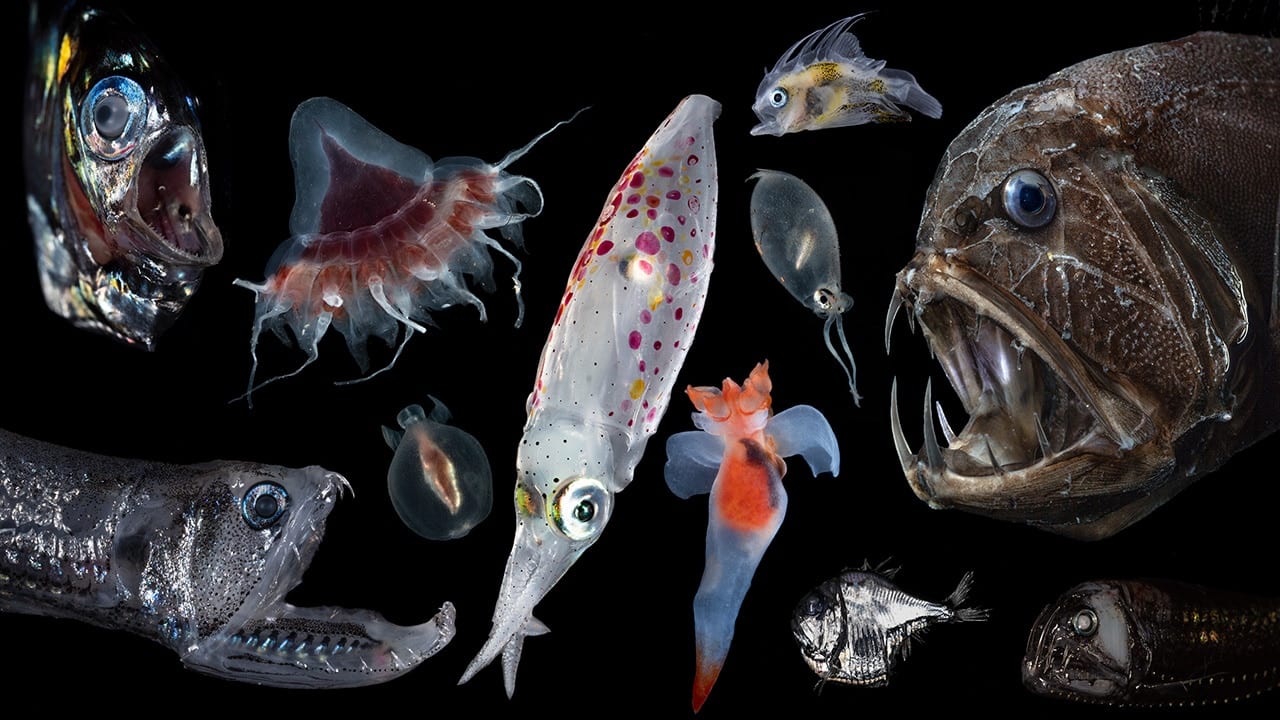
The ocean’s twilight zone
The ocean twilight zone, also called the mid-water or the mesopelagic, is the vast swath of ocean below the sunlit surface waters. This zone is generally considered to be about 200 to 1,000 meters (650 to 3,300 feet) below the surface. The upper extent of the ocean twilight zone is more aptly defined by light rather than by depth: The zone begins below the sunlit surface layer, where light becomes too dim to support photosynthesis (generally speaking this is around 200m, but that depth varies with light intensity and water clarity). The ocean twilight zone stretches around the world from the Arctic to the Antarctic, mainly in the “high seas” beyond the control of any one nation.
Processes and food webs in the ocean twilight zone are tightly connected with those in surface waters and the deep ocean. The ocean twilight zone plays an important, but little-studied role in transferring carbon from surface waters to the deep ocean, a process that contributes to removing carbon dioxide from the atmosphere and helps to regulate Earth’s climate. In addition, animals in the twilight zone are an important source of food for many marine animals, including commercially valuable species like tuna and swordfish. In the future, twilight zone resources could be extracted as feed to support expanded aquaculture production, or for nutraceutical production.
Why is the twilight zone important?
Global climate
- Biological processes in the twilight zone are responsible for sequestering 2 to 6 billion metric tons of carbon annually—at least double and perhaps as much as six times the amount of carbon emitted by all automobiles worldwide—which has an estimated value of $300 to $900 billion annually.
- Without this service, atmospheric carbon dioxide levels could be as much as 200 ppm higher than they are today, and the value of such a loss in sequestration service could amount to between $170 billion and $3 trillion in mitigation costs and $23 to $401 billion in adaptation costs by the end of the century.
- Reducing uncertainty in estimates of how much carbon gets from the surface to the deep ocean—and how quickly—is on the order of $500 billion. The value is affected by the accuracy of predictions, the economic parameters, and the initial range of uncertainty.
Food security and ocean ecosystems
- With the global population expected to surpass 8 billion in 2025, we will increasingly be dependent on aquaculture for protein. Aquaculture operations are expected to grow by 37 percent from 2016 to 2030, requiring new sources of feed that global markets are looking toward the twilight zone to provide. Additionally, the twilight zone resources could support an increased demand for nutraceutical
- In 2014, Xabier Irigoien estimated fish biomass in the twilight zone to be 10 times higher than previous estimates and peaking scientific interest in this little explored region. Scientists on the WHOI OTZ team are on the path of refining Irigoien’s estimate and suspect that the twilight zone has 2 or 3 times the previous estimate of fish biomass (not 10 times).
- At the moment, the economic value of twilight zone fisheries does not appear to support the cost of ramping up industrial-scale fishing at depth, but that could change as technological developments and the demand for fishmeal and fish oil to supply aquaculture operations tip the scale towards profitability.
- The animals in the twilight zone are a food source for life in the surface ocean, including economically important fisheries such as tuna and swordfish, as well as charismatic predators such as whale sharks, blue sharks, white sharks, beaked whales, and others.
WHOI’s Ocean Twilight Zone (OTZ) project
WHOI’s Ocean Twilight Zone project will close critical gaps in scientific knowledge in a targeted study area (the Northwest Atlantic Ocean) and identify a path forward for global understanding and appreciation of the mesopelagic. The team will develop compelling scientific methodologies, low-cost pervasive survey and monitoring technologies, productive international collaborations, and effective means of engaging the general public and policymakers.
Key facts:
- The OTZ project began in April 2018 with a 6-year, $32 million award from The Audacious Project, a collaborative endeavor housed at TED. This is the largest philanthropic supported project in WHOI’s history. Although the OTZ project is well funded, much more scientific research will be needed to develop a global understanding of mesopelagic ecosystems.
- The WHOI team consists of 13 scientists, engineers, and marine policy experts, as well as program office and engagement personnel, all working in close collaboration to advance the science and technology needed to understand this critical zone of the ocean.
- The OTZ project has made it a priority to collaborate with global colleagues in order to accelerate knowledge. There are more than a dozen national research programs around the world pursuing different angles of twilight zone research or focusing on different geographic regions of the ocean. The members of the OTZ project have been instrumental in establishing the “Joint Exploration of the Twilight Zone Ocean Network” (JETZON), which intends to act as an international coordinator and focal point for twilight zone studies.
Key results essential to success:
- Quantified biomass distributions of twilight zone biota and how and why they vary in time and space.
- Description of twilight zone biodiversity, trophic dynamics, and life histories.
- Quantified twilight zone carbon transport and sequestration of CO2 in the deep-sea.
- Inform high seas ocean policy development to ensure that the mesopelagic zone is duly considered as one of the critical ocean ecosystems.
- Engagement of the public to increase their awareness of the ocean twilight zone and build public value for responsible management.
- Partnerships with international groups to share technology and build capacity for global impact.
- Development of new smaller, low-cost platforms and sensors to make twilight zone observations more pervasive.
- Design and deployment of an Open Data Platform that enables international collaboration in mesopelagic sciences.
- Establish WHOI as a long-term, sustainable center of excellence for mesopelagic studies and engagement.
Why is this research urgently needed?
Global climate: The impacts of climate change are already being felt across the globe. Scientists have long known that the ocean’s twilight zone plays an essential role in sequestering carbon dioxide gas from the atmosphere as particulate and dissolved carbon in the deep ocean, but the efficiency of the ocean’s “biological carbon pump” remains uncertain and could have significant implications for future climate policy.
Fisheries and food webs: Commercial fishing interests in countries such as Norway and Japan are already fishing twilight zone species from surface waters (krill, copepods) and are looking to expand their reach into the twilight zone. This would be completely legal, since few to no regulations exist pertaining to fishing the twilight zone, which is largely in the open ocean, beyond nationally controlled exclusive economic zones (EEZs). WHOI OTZ team members are in a race against time, working to ensure that understanding outpaces exploitation in order to sustainably manage this critical ecosystem. We can’t turn back the clock on damage done to other regions of the ocean, but we can learn from past mistakes and take a different path forward to sustainably manage mesopelagic resources.
International ocean policy: The vast majority of the twilight zone falls outside of national boundaries in the open ocean, which is largely unregulated. The UN and others have only just begun discussions about how to regulate operations that would exploit twilight zone resources in the future, but science needs to be a part of those discussions in order to ensure sustainable use.
How is WHOI’s OTZ project making a difference?
Global climate: OTZ marine chemist Ken Buesseler is leading the team’s efforts to quantify the twilight zone’s role in global climate. He has worked with OTZ policy experts Di Jin and Porter Hoagland to put an economic value on twilight zone ecosystem services. Biologist and phytoplankton expert Heidi Sosik is also working to advance understanding of carbon transport through the twilight zone.
Fisheries and food webs: OTZ scientists are quantifying fish and invertebrate biomass and species diversity in the twilight zone, analyzing predator-prey relationships, and making observations of animal behavior. The team members working in this area include Simon Thorrold (food webs), Andone Lavery (acoustics and biomass estimates), Heidi Sosik (food webs/carbon), Joel Llopiz (life history & behavior/biomass/biodiversity), and Annette Govindarajan (eDNA and biodiversity).
International ocean policy: The OTZ team is also working to inform and influence ocean policy related to the twilight zone, and to make this crucial ocean region an integral component of international policy conversations that have historically focused only on the top and bottom layers of the ocean. Efforts have focused on United Nations (UN) negotiations related to the conservation and sustainable use of marine biological diversity of areas beyond national jurisdiction (BBNJ), and the UN Decade of Ocean Science for Sustainable Development.
- Biodiversity Beyond National Jurisdiction or BBNJ
- Members of the OTZ team have participated in all of the BBNJ negotiations sessions.
- The mesopelagic ecosystem services report published by our team was explicitly cited in a recent UN document summarizing extant proposals put forward to revise the BBNJ treaty language.
- The latest BBNJ session held virtually in Oct 2020 highlighted the mesopelagic using figures and photos provided by the OTZ team.
- UN Decade of Ocean Science for Sustainable Development
- Members of the OTZ team, including Porter Hoagland, Michael Holland, and David Scully, have participated in key UN planning meetings and are currently in discussions with the Intergovernmental Oceanographic Commission at UNESCO
- Fisheries biologist Joel Llopiz and OTZ project advisor Michael Holland participated in the first Global Planning meeting in Copenhagen in 2019, where they were successful in introducing the ocean twilight zone into the discussions.
New technologies: WHOI researchers and their collaborators are designing and testing new tools and next-generation robotic vehicles to explore this crucial part of the ocean, shed light on its unique inhabitants, and better understand the complex role it plays in our planet’s climate.
- Mesobot is a new hybrid robot, specifically engineered to study life in the ocean twilight zone. It can maneuver under its own power for more than 24 hours, using its cameras and lights to slowly follow individual animals while making a variety of other measurements and taking samples of eDNA. This robot was designed at WHOI by a team led by scientist and engineer Dana Yoerger and completed its first scientific mission in summer of 2019.
- Deep-Seeis a new, sensor-filled platform for observing animals in the ocean twilight zone, developed by a team led by scientist and engineer Andone Lavery. Using this tool, OTZ scientists can more accurately estimate the biomass (amount) and biodiversity (species or type) of twilight zone animals. Towed from a ship, weighing about 2,500 pounds, and extending 16 feet in length, the Deep-See carries a multitude of camera systems, sonars, and sensors.
- MINIONS, or MINiature IsOpycNal floats, are small, inexpensive devices designed to track carbon-rich particles as they sink through the twilight zone. The MINIONS carry camera and lighting systems to photograph “marine snow” (carbon-rich detritus) as it falls from above. Each float drifts with the currents at a specific depth and is programmed to surface at a specific time. By deploying a fleet of these devices over a huge area, the OTZ team will be able to observe marine snow throughout the twilight zone and take widespread measurements of carbon flux that would otherwise be impossible to achieve. The development of MINIONs is led by physical oceanographer Melissa Omand (University of Rhode Island) in collaboration with OTZ team member Ken Buesseler.
Public engagement and ocean literacy
- Increasing public awareness of the ocean twilight zone is key to achieving project success. The OTZ team aims to inspire a movement of informed citizens committed to its sustainable use—but in order to do so, it will be critical for the team to help lay audiences understand why the zone affects their daily lives.
- There are three pillars to the Engagement component: 1) Audience Growth, 2) Academic Engagement and 3) Policy Influence.
- The OTZ team has emphasized visual storytelling to capture the public’s interest and imagination. The team has seen a distinct increase in awareness of the twilight zone, its role in global climate and food security, and the threats it currently faces over the past two years.
For additional information about the Ocean Twilight Zone project or to get in touch with a member of the team, please contact the OTZ Program Office. You can reach OTZ Program Manager Phil Renaud at prenaud@whoi.edu and 508-289-2216, and OTZ Project Manager Kathryn Baltes at kbaltes@whoi.edu and 508-289-4906.