Project: Ocean Observatories Initiative (OOI)
Sr. Program Manager: Paul Matthias (AOP&E, LOSOS 213)
Principal Investigator: John Trowbridge (AOP&E, LOSOS 204)
Co-Principal Investigator: Al Plueddemann (Physical Oceanography, Clark 202A)
Location: Quissett Campus
The Ocean Observatories Initiative
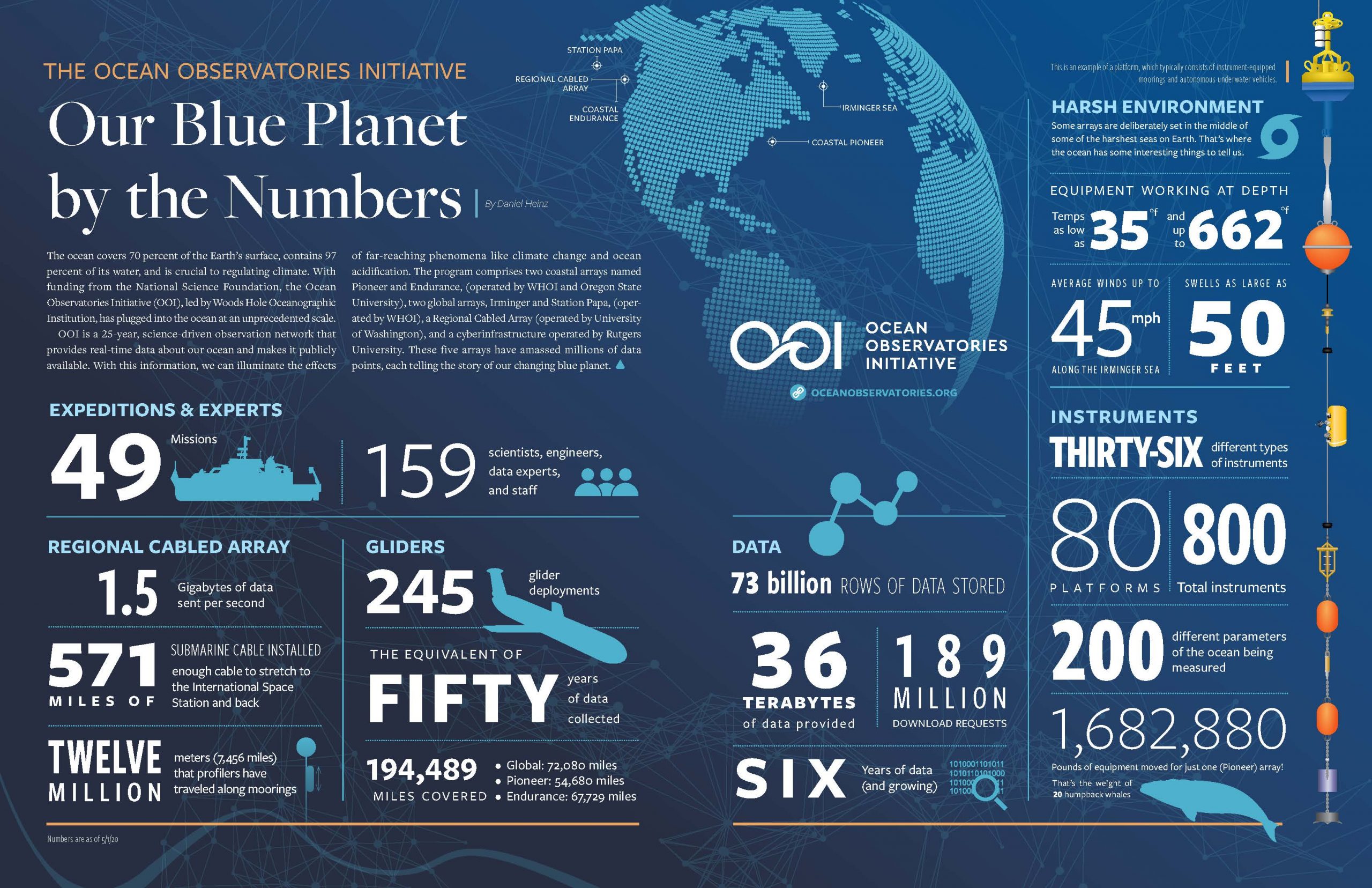
The Ocean Observatories Initiative (OOI) is a National Science Foundation (NSF) funded Major Facility, consisting of seven multidisciplinary instrumented arrays in the Pacific and Atlantic Oceans. Following initial NSF funding in 2009, the OOI was accepted and commissioned in 2016, transitioning to a planned 25-year Operations and Maintenance phase. Since 2018, the OOI has been led by the Program Management Office (PMO) at WHOI with a budget of $44 million per year, with sub-awardees at Oregon State University (OSU), Rutgers University, and University of Washington.
OOI mission
OOI is a science-driven ocean observing network that delivers real-time data to address critical science questions regarding the world’s ocean. This advanced system of integrated, scientific platforms and sensors measure physical, chemical, geological, and biological properties and processes from the ocean surface to the seafloor in key coastal and open-ocean sites of the Atlantic and Pacific.
The OOI was designed as a long-term project to collect ocean data for 25 years or more. This longevity makes it possible to measure and directly observe both short-lived episodic events and longer-term changes occurring in the ocean. Such data make it possible to better understand ocean processes and how the ocean is changing and responding to climate change, ecosystem variability, ocean acidification, plate-scale seismicity and submarine volcanoes, and carbon cycling.
OOI infrastructure
The OOI is comprised of five active mooring arrays:
- The Coastal Pioneer Array (in the Northwestern Atlantic, 75 nautical miles south of Martha’s Vineyard at the edge of the continental shelf)
- The Global Irminger Sea Array (in the Northeastern Atlantic at the southern tip of Greenland)
- The Station Papa Array (in the Gulf of Alaska)
- The Coastal Endurance Array (in the Northeastern Pacific Ocean off the coasts of Oregon and Washington)
- The Regional Cabled Array (which runs across the Juan de Fuca plate in the Northeastern Pacific Ocean off the coast of Oregon)
- Two other global arrays have been discontinued: the Global Southern Ocean Array (in 2020) and the Global Argentine Basin Array (in 2018).
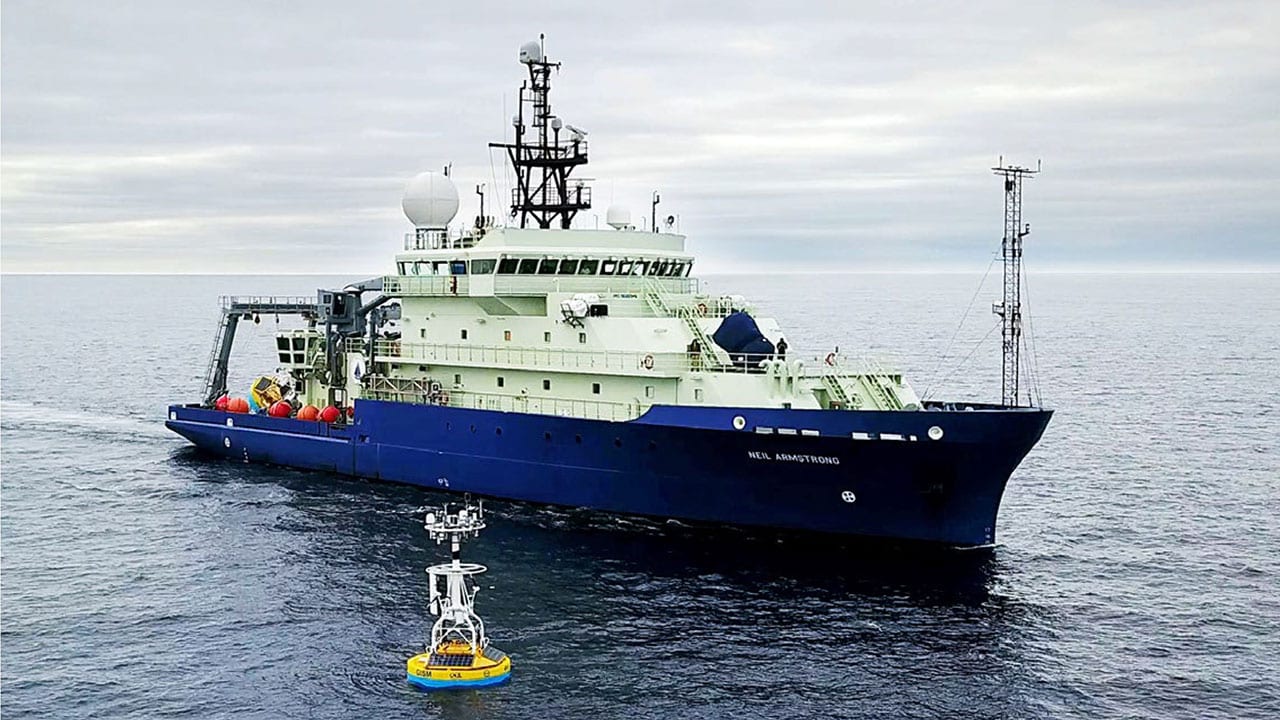
The OOI arrays include moorings, profilers, autonomous underwater vehicles (AUVs), ocean gliders, cabled infrastructure, and cyberinfrastructure. Together, the OOI arrays support over 800 instruments that measure 200 different parameters, providing a wealth of information about meteorology, ocean temperature, salinity, currents, nutrient concentrations, and productivity. The arrays collect data around the clock, 365 days a year. All OOI data are freely available online to anyone with an Internet connection.
How is OOI is advancing our understanding of the ocean?
Scientists throughout the oceanographic community are using OOI data to understand critical ocean processes and phenomena. Some examples of how OOI data are being used to advance ocean science include:
- Using data from the Irminger Sea Array, scientists reported the warm North Atlantic summers can increase the risk of a shutdown of ocean convection and global ocean currents (Nature Climate Change).
- Data from the Regional Cabled Array have provided insight into how and why tides trigger of earthquakes at mid-ocean ridges (Nature Communications).
- Scientists have also used data from the Regional Cabled Array to demonstrate that submarine volcanic eruptions can be predicted by measuring the deformation of the seafloor, which provides information about magma movements deep inside the Earth. This insight is being used to inform eruption forecasting (Science).
- Data from the Coastal Endurance Array were used to track the movement of freshwater runoff from Oregon’s Columbia River into the ocean and then back towards shore. Increases in freshwater can change nutrient cycling and sediment deposition in estuaries and impact the productivity of coastal ocean ecosystems (Nature Scientific Reports).
- WHOI scientists, Glen Gawarkiewicz, Robert Todd, Al Plueddemann, and Magdalena Andres, and NOAA scientist James Manning used data from the Pioneer Array to report a direct intrusion of Gulf Stream water at the edge of the continental shelf south of New England—the first time this phenomenon has been observed. Warming of normally cold shelf water has direct negative implications for commercial fisheries such as lobstering (Nature Scientific Reports).
- WHOI scientists Glen Gawarkiewicz and Weifeng (Gordon) Zhang used data from an OOI glider to help reveal previously unknown mechanisms for water and nutrient exchange at the edge of the continental shelf. These shifting patterns could have major impacts on marine life and fisheries off New England (Geophysical Research Letters).
OOI program management and operation
- WHOI scientists and engineers have led the development, building, testing, and first deployment of many of the key technologies that make OOI possible.
- WHOI has three major roles in OOI: hosting the OOI Program Management Office; operation and management of three of OOI’s arrays—the Coastal Pioneer Array, and the Global Irminger Sea and Station Papa Arrays; and the management of the Cyberinfrastructure (CI).
- The University of Washington is responsible for the Regional Cabled Array and the cabled components of the Coastal Endurance Array. Oregon State University is responsible for the uncabled components of the Coastal Endurance Array.
- Rutgers, The State University of New Jersey, has provided OOI’s cyberinfrastructure systems management since 2014 and will continue to do so through the end of 2021. In October 2020, Oregon State University assumed responsibilities for the systems management of the Cyberinfrastructure through September 2023, following a transition period with Rutgers to ensure a smooth and seamless handoff of data and responsibilities.
OOI program history
- The OOI officially launched in 2009, when NSF and the Consortium for Ocean Leadership signed a cooperative agreement to support the construction and initial operation of OOI’s cabled, coastal, and global arrays.
- The launch represented the culmination of work begun decades earlier, when ocean scientists in the 1980s envisioned a collection of outposts in the ocean that would gather data around the clock, in real- and near-real time for years at a time. The vision was to enhance the scientific community’s ability to observe complex oceanographic processes that occur and evolve over time scales ranging from seconds to decades and spatial scales ranging from inches to miles.
- In 2018, NSF awarded WHOI a five-year, $220 million contract to operate and maintain the OOI, leading a coalition of academic and oceanographic research organizations including the University of Washington, Oregon State University, and Rutgers, The State University of New Jersey.
- The current OOI 2.0 phase of the program ends on September 30, 2023, when the program is expected to be renewed or recompeted.